


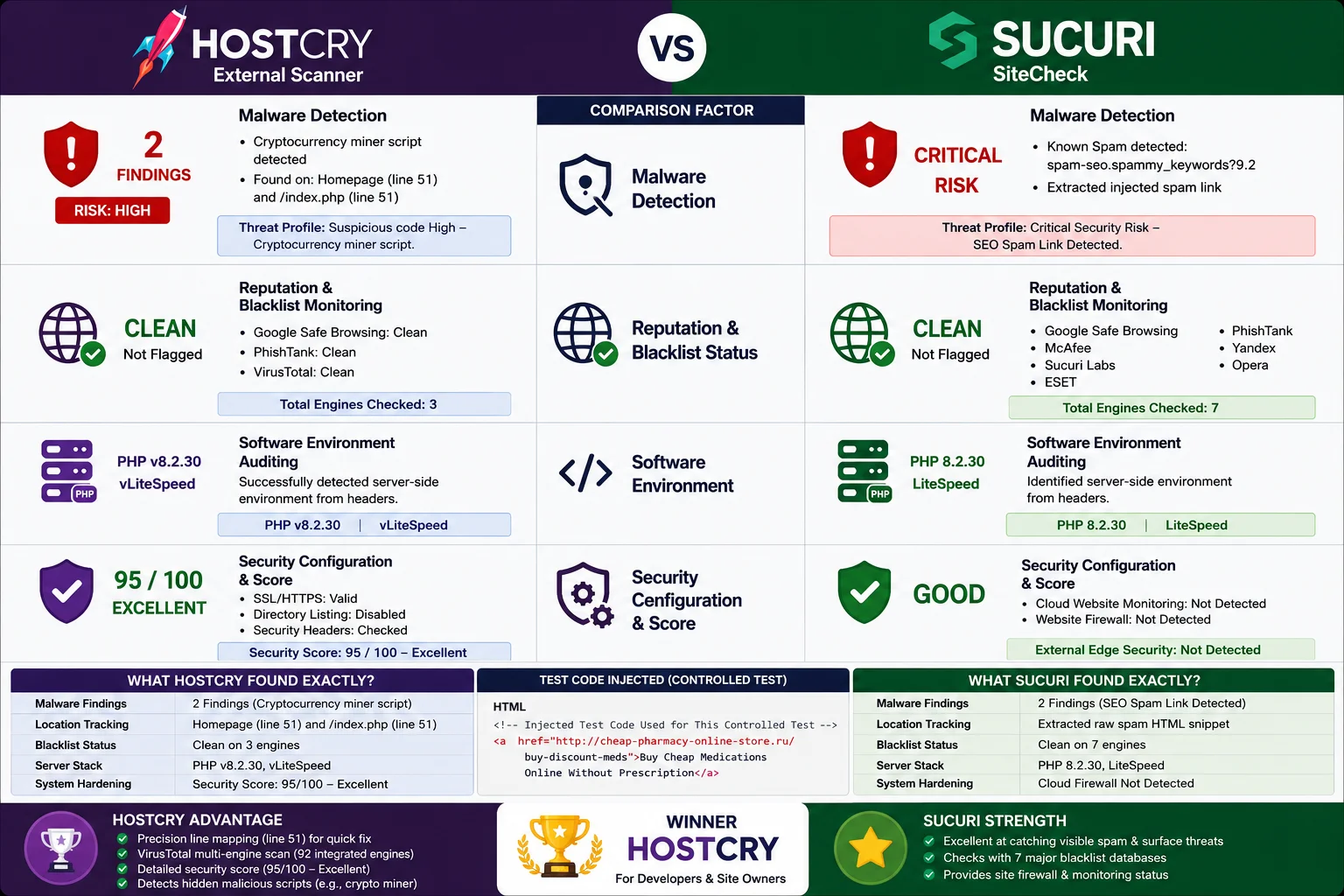
As web developers, we constantly emphasize the importance of robust website security. To put external scanning tools to the test, we decided to conduct a controlled experiment on our testing domain.
The Exact Test Payload Used During Testing
Below is the identical spam anchor element code that was parsed and injected during our simulation, which both tools analyzed from the frontend:
<!-- Injected Test Code Used for This Controlled Test -->
<a href="http://cheap-pharmacy-online-store.ru/buy-discount-meds">
Buy Cheap Medications Online Without Prescription
</a>
If you want to test your own domain instantly to see what external scripts or vulnerabilities are visible to the public, you can use our official Malware Checker Tool.
Disclosure: This comparison was performed by the HostCry team using our internal testing environment. The purpose of this experiment was to evaluate how both scanners report externally visible threats under identical conditions.
Part 1: Feature-by-Feature Comparison (Client-Side Performance)
Because both of these checks were conducted remotely using only the domain name, neither tool could directly read the backend server files or database. Instead, they analyzed the public-facing HTML, JavaScript, and server response headers.
1. Malware Detection Feature
HostCry Scanner Performance
Flagged 2 findings (Risk: High). By analyzing publicly accessible frontend scripts and execution patterns, it successfully deduced that a cryptocurrency miner script was executing on the homepage (line 51) and the main /index.php routing file stream.

Sucuri SiteCheck Performance
Flagged a critical security risk. It directly caught the visible payload in the public source code, reporting known spam detection and extracting the exact injected pharmaceutical link text.

2. Reputation & Blacklist Monitoring Feature
Checking whether a domain's external reputation is clean or compromised is a core capability of remote scanners.
HostCry Scanner Performance
HostCry checks reputation using VirusTotal integration, which aggregates 92 vendor engines including major antivirus brands, malware detection systems, and global threat intelligence networks. The scan also includes Google Safe Browsing, PhishTank, and other security sources. Result: Clean (Not flagged).

Sucuri SiteCheck Performance
Sucuri checks approximately 7 cloud security authorities, including Google Safe Browsing, McAfee, Sucuri Labs, ESET, PhishTank, Yandex, and Opera. Result: Clean.

3. Software Environment Auditing Feature
Even from the outside, scanners can read HTTP response headers to identify server technology.
HostCry Scanner Performance
Successfully detected server-side environment details from headers:
- PHP v8.2.30
-
LiteSpeed web server.

Sucuri SiteCheck Performance
Detected:
- PHP 8.2.30
- LiteSpeed
However, the CMS and hosting provider were marked as unknown.

4. Security Configuration & Score Feature
HostCry Scanner Performance
Generated a detailed security score: 95/100 (Fair)
- SSL/HTTPS verified
- Directory listing disabled
-
Some security headers could not be fully validated through external analysis alone.

Sucuri SiteCheck Performance
Detected absence of:
- Web application firewall
- Cloud monitoring/edge protection services
Part 2: Technical Analysis — Exact Line Precision vs Surface-Level Detection
When dealing with active website exploitation, identifying an issue is only half the job — locating the exact source is what saves developer time.
This controlled experiment highlights a major difference in how both tools present findings.
1. HostCry Malware Checker: Precision Line Mapping
HostCry analyzes frontend execution patterns and correlates suspicious behavior with the application entry points identified during testing.
Key Findings:
-
Threat: Cryptocurrency miner script (suspicious behavior)
-
Exact Location: Homepage (line 51) and /index.php (line 51)
This allows developers to immediately open the file and remove or fix the malicious code without searching manually.
2. Sucuri SiteCheck: Surface-Level Detection
Sucuri operates as a surface-level external scanner. It detects visible symptoms but does not provide backend context.
Key Findings:
-
Threat: Critical SEO spam detection
-
Output: Raw injected HTML snippet from frontend source
<a href="http://cheap-pharmacy-online-store.ru/buy-discount-meds">
Buy Cheap Medications Online Without Prescription
</a>
<a href="http://cheap-pharmacy-online-store.ru/buy-discount-meds">
Buy Cheap Medications Online Without Prescription
</a>Sucuri does not provide:
- File structure
- Directory mapping
- Line numbers
It shows only what is visible in the rendered source.
Part 3: Blacklist & Reputation Feature — HostCry’s Multi-Engine Advantage
Another major advantage of HostCry is its reputation and blacklist engine.
While Sucuri checks a limited set of public security databases, HostCry integrates directly with VirusTotal.
VirusTotal performs a multi-engine reputation scan across 92 security vendor engines simultaneously, including global antivirus companies, malware detection networks, and threat intelligence systems.
This ensures that if even one security vendor flags a domain, HostCry will detect it through its aggregated scanning system.
Part 4: What Was Found Exactly by Each Tool
Feature HostCry External Scanner Sucuri SiteCheck Malware Findings 2 findings (cryptominer behavior) Critical SEO spam detected Location Tracking Line 51 + file-level mapping Raw HTML snippet only Blacklist Status 92-engine VirusTotal aggregation 7 security databases Server Stack PHP 8.2.30 + LiteSpeed PHP 8.2.30 + LiteSpeed Security Score 95/100 Firewall not detected
| Feature | HostCry External Scanner | Sucuri SiteCheck |
|---|---|---|
| Malware Findings | 2 findings (cryptominer behavior) | Critical SEO spam detected |
| Location Tracking | Line 51 + file-level mapping | Raw HTML snippet only |
| Blacklist Status | 92-engine VirusTotal aggregation | 7 security databases |
| Server Stack | PHP 8.2.30 + LiteSpeed | PHP 8.2.30 + LiteSpeed |
| Security Score | 95/100 | Firewall not detected |
Part 5: Final Verdict & Conclusion
When a security scan is limited to external analysis only, tools compete based on how actionable their output is.
Conclusion: HostCry Provides More Actionable Intelligence
Sucuri effectively captures visible malicious content, but its output remains surface-level and lacks deep context.
HostCry goes further by:
- Correlating suspicious behavior with application entry points
- Providing structured security scoring
- Aggregating 92 security engines via VirusTotal
- Delivering developer-actionable insights
For developers and site owners who need clarity and fast remediation, HostCry provides a more structured and actionable security report.
Why Choose HostCry for Web Security
External scanners are useful for quick checks, but they only analyze what is publicly visible. Hidden backdoors, inactive shells, or deep file-level infections cannot be fully detected externally.
HostCry enhances security by offering automated server-side scanning, included free with all HostCry web hosting plans, that checks:
- Backend files
- Databases
- Configuration layers
- Real-time threat detection
This ensures deeper protection beyond surface-level scanning.
Final Recommendation
Based on this controlled evaluation, HostCry delivered more detailed and actionable findings within our testing environment.
HostCry focuses not just on detection, but on actionable security intelligence for real-world remediation.
Scan Your Website Now
Want to check whether your website is exposing suspicious scripts, malware indicators, or security weaknesses?
Run a free scan using the HostCry Web Security Tool and receive an instant security report.
Need continuous protection? Explore HostCry hosting plans that include automated malware scanning and proactive security monitoring at no additional cost.