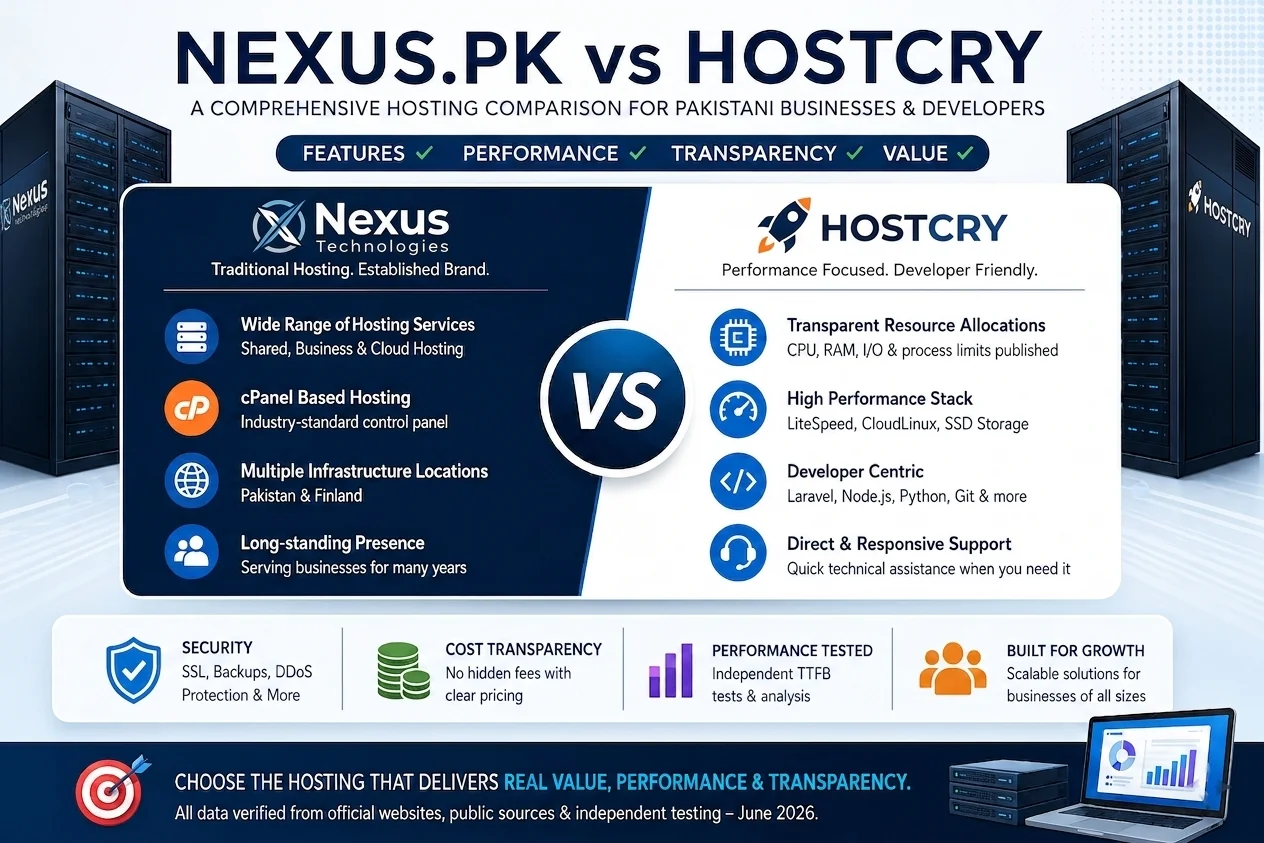
Nexus.pk offers traditional cPanel-based shared hosting in Pakistan, but its entry-level plans lack transparency on key specs like CPU and RAM, and pre-sales support redirects technical queries to manual callbacks. Hostcry outperforms with lower pricing (Rs. 1,500/year vs. Rs. 4,425), larger storage, free SSL/backups, and publicly published resource allocations (CPU cores, RAM, I/O limits). For Pakistani businesses and developers seeking affordable, high-performance hosting with clear infrastructure details, Hostcry delivers stronger overall value, especially at entry and premium tiers.
Introduction
Nexus.pk is one of Pakistan's long-standing hosting brands and offers a wide range of shared, business, and cloud hosting services. The company operates infrastructure in both Pakistan and Finland and primarily targets businesses seeking traditional cPanel-based hosting environments.
Hostcry, on the other hand, focuses heavily on performance optimization, developer tooling, transparency, and direct technical support. Its hosting stack is built around LiteSpeed Web Server, CloudLinux isolation, and clearly defined resource allocations.
This comparison reviews publicly available plan specifications, support interactions, public reputation signals, and infrastructure transparency to determine which provider delivers stronger value for Pakistani businesses and developers.
Entry-Level Shared Hosting Comparison
Feature
Nexus Smart Host Silver
Hostcry Shared Starter
Winner
Annual Price
Rs. 4,425/year
Rs. 1,500/year
Hostcry
Storage
3 GB SSD
5 GB SSD
Hostcry
Bandwidth
100 GB/month
100 GB/month
Tie
Email Accounts
10
5
Nexus
Databases
5
10
Hostcry
FTP Accounts
5
2
Nexus
Control Panel
cPanel
Premium cPanel
Tie
Free SSL
Not specified on the base plan
Included
Hostcry
Free Backups
Paid Addon
Included
Hostcry
Shared Hosting Value Analysis
Nexus's entry-level hosting package provides a conventional shared hosting environment with moderate limits suitable for small websites.
However, Hostcry delivers stronger overall value by offering larger storage allocation, twice the number of databases, free SSL certificates, automated backups, and a substantially lower annual cost.
For startups, blogs, and small businesses, Hostcry's entry pricing of Rs. 1,500/year makes it one of the more affordable hosting options available in Pakistan.
At higher tiers, Nexus significantly increases storage quotas and email limits. However, Hostcry focuses more heavily on flexibility and scalability.
Feature
Nexus Smart Host Platinum
Hostcry Shared Advance
Price
Rs. 17,700/year
Rs. 6,499/year
Storage
50 GB SSD
Unlimited SSD Storage
Websites
5 total (1 primary + 4 addon domains)
Unlimited
Email Accounts
50
Unlimited
Databases
50
Unlimited
Backups
Weekly
Free Backups
CPU Allocation
Not Published
4 Core
RAM Allocation
Not Published
1 GB
I/O Limit
Not Published
2 MB/s
Resource & Support Transparency: The Crucial Difference
One major differentiator between the two providers is infrastructure transparency and the agility of pre-sales technical support.
Hostcry publicly publishes its CPU cores, RAM allocations, I/O limits, process limits, and account restrictions for every hosting plan, giving developers full clarity before they buy.
During our June 2026 evaluation, Nexus did not publicly display CPU, RAM, or I/O allocations on its website for the evaluated plans. A pre-sales interaction via WhatsApp support was also reviewed to understand how technical specifications are handled during inquiry.
Caption: Nexus support routing immediate, technical pre-sales questions to a manual sales callback by demanding user details.
Pre-sales interaction behavior
In response to a direct request for technical specifications (CPU and RAM allocation for entry-level hosting plans), support requested additional customer details, such as name and city, before proceeding with further assistance. At the time of interaction, no immediate numerical resource specifications were provided through chat.
Caption: Nexus providing high-profile government and corporate client domains as a speed reference instead of publishing standard plan resource limits.
Infrastructure Obscurity: When requested to provide a hosted domain to evaluate live server response speeds, support provided governmental and corporate clients (sbca.gos.pk, pakshaheen.com.pk). While these show they host substantial entities, they do not reflect the environment, resource constraints, or performance of an off-the-shelf shared hosting plan.
Without published compute allocations or direct, technical answers from chat support, prospective developers and businesses may find it difficult to estimate real-world application performance or make fast buying decisions.
Putting the Infrastructure to the Test: Live TTFB Analytics
To move past empty marketing claims, we took the primary showcase domain provided by Nexus support—sbca.gos.pk—and ran it through independent global Time to First Byte (TTFB) testing tools on June 22, 2026. The results were highly alarming for any business relying on fast page speeds.
The second test, performed using Flying TTFB, shows consistent multi-region latency behavior.
Key observations:
Response times generally ranged between ~2,000ms to 3,000ms across multiple regions
Nearby regions such as Mumbai (~3,011ms) and Delhi (~2,934ms) also showed elevated latency
No region consistently demonstrated sub-1,000ms TTFB during the test window
Test Conditions:
Date: June 22, 2026
Tools: SpeedVitals, Flying TTFB
Mode: Uncached public endpoint
Node coverage: global multi-region
Limitations: single domain sample
Why This Data Matters
TTFB (Time to First Byte) measures how quickly a server begins responding after a request is made. It reflects a combination of backend processing speed, server load, and network routing efficiency.
Higher TTFB values can:
Increase page load time
Negatively affect user experience
Contribute to higher bounce rates
Impact SEO performance for content-heavy and e-commerce websites
The results above represent observed behavior from a publicly accessible test domain under global measurement conditions.
WordPress Hosting Comparison
Modern WordPress websites depend heavily on CPU power, RAM allocation, and server-level caching.
Feature
Nexus Smart Host Gold
Hostcry wp-Professional
Price
Rs. 14,750/year
Rs. 5,988/year
Storage
30 GB SSD
20 GB SSD
Websites
3 total
5
CPU
Not Published
6 Core
RAM
Not Published
6 GB
LiteSpeed
Not Specified
Included
WordPress Optimization
Standard
WordPress Optimized
Caching
Not Specified
Included
WordPress Verdict
Nexus offers higher raw storage capacities across several plans.
Hostcry, however, provides substantially more technical detail regarding resource allocations and includes a performance-oriented stack consisting of LiteSpeed Web Server, integrated caching, and dedicated CPU and RAM allocations.
For WooCommerce stores, plugin-heavy websites, and high-traffic WordPress deployments, compute resources are often more important than storage alone.
Nexus's Business Hosting range targets agencies and businesses managing multiple websites.
Hostcry approaches higher-tier hosting through dedicated cloud environments with clearly defined resources.
Feature
Nexus Supreme Infinity
Hostcry Cloud Guru
Annual Price
Rs. 141,600
Rs. 49,999
Websites
35
10
Storage
150 GB SSD
150 GB SSD
Bandwidth
1000 GB
Unlimited
RAM
Not Published
16 GB Dedicated
CPU
Not Published
10 Dedicated Cores
I/O
Not Published
20 MB/s
Email Accounts
Unlimited
Unlimited
Control Panel
cPanel
cPanel
Cloud Infrastructure Verdict
Nexus provides larger website allowances and substantial business-focused limits.
Hostcry differentiates itself by publishing complete compute allocations, including dedicated CPU cores, RAM, and I/O limits, allowing customers to accurately evaluate expected performance.
Hidden Costs & Paid Addons: Understanding the Real Cost of Ownership
When evaluating web hosting providers, the advertised plan price often represents only part of the overall cost. Additional charges for common hosting features can significantly increase the total yearly expense.
During our review, we found that Nexus sells a number of commonly used hosting features as separate paid add-ons.
Nexus Paid Addons
Addon
Additional Cost
Addon Domain
$5/year
Parked Domain
$5/year
Domain ID Protection
$2/year
DNS Zone Management
$6/year
Daily Offsite Backup
$5/month
Weekly Offsite Backup
$3/month
Monthly Offsite Backup
$1/month
Basic WAF/DDoS Protection
$6/month
Pro WAF/DDoS Protection
$30/month
Additional 10 GB Bandwidth
$3/month
Additional 50 GB Bandwidth
$10/month
Dedicated IPv4 Address
$7/month
Platform Change Request
$10
These additional charges can substantially increase the effective annual cost of hosting, particularly for businesses requiring enhanced security, backup retention, or multiple domains.
For example, a customer requiring:
Daily backups
Basic WAF/DDoS mitigation
One addon domain
would pay approximately an additional $137 per year on top of the base hosting cost.
Hostcry Included Features
Hostcry includes many of these features at no additional charge across its hosting plans:
Free SSL Certificates
Free Backups
Free DDoS Protection
Free Cloudflare CDN Integration
Free Addon Domains (on eligible plans)
Free Malware Scanning
Free Web Application Firewall (WAF)
Free Account Isolation through CageFS
Free Migration Assistance
Because these features are bundled into the hosting plans, customers can more accurately estimate their long-term hosting costs without needing to purchase multiple optional services.
Cost Transparency Verdict
Nexus follows an add-on-based pricing model where advanced functionality, additional security, and enhanced backup retention may require extra purchases.
Hostcry follows a bundled pricing model in which many commonly requested security, backup, and performance features are included by default.
For businesses seeking predictable yearly costs and fewer additional purchases, Hostcry offers a more transparent total cost structure.
Developer Ecosystem & Modern Application Support
Developer support is increasingly important for agencies and modern businesses.
Hostcry
Laravel Hosting
Node.js Hosting
Python Hosting
Ruby Support
Passenger Applications
Git-friendly environments
LiteSpeed stack
CloudLinux isolation
Nexus.pk
At the time of writing, Nexus primarily markets traditional shared hosting solutions. No dedicated hosting environments specifically targeting Laravel, Node.js, Python, or other modern application frameworks were publicly advertised.
For developers deploying modern web applications, Hostcry currently provides a broader ecosystem.
Public Reputation & Transparency
Publicly visible reviews and company history often play an important role when evaluating a hosting provider.
During our review, we observed that the Nexus homepage prominently displayed the statement "8,435+ reviews on Trustpilot." However, the publicly accessible Trustpilot profile displayed 6 reviews at the time of verification.
We were unable to independently verify the origin of the larger review figure.
Similarly, Nexus states on its website that it has been providing hosting services since 1998. Public PKNIC WHOIS records for the nexus.pk domain indicates a creation date of January 20, 2006. While it is possible that the company operated under a different brand, domain, or legal entity prior to 2006, we could not independently verify earlier public records.
Transparency and independently verifiable information are important considerations when selecting a long-term hosting provider.
All-Inclusive Bundled Value: Free SSL, automated backups, DDoS mitigation, and malware scanning included on all tiers by default. Complete Compute Transparency: Explicitly publishes CPU core, dedicated RAM, and I/O limit ceilings upfront.
Modern Developer Infrastructure: Fully optimized out of the box for Git, Laravel, Node.js, and Python workflows.
High-Performance Architecture: Uses a premium LiteSpeed Web Server, CloudLinux isolation, and a built-in caching stack.
Highly Disruptive Pricing: Massive resource allocations starting at a highly affordable Rs. 1,500/year.
Focused Portfolio: Focuses squarely on optimized cloud, shared, and WordPress setups rather than broad traditional infrastructure.
Younger Brand Profile: Holds fewer total legacy operational years in the local market compared to veteran corporate brands.
Nexus.pk
Long-Standing Presence: An established legacy name operating in the Pakistani hosting market since 2006.
Generous Top-Tier Storage: Provides massive, raw storage quotas on high-tier enterprise business packages.
Diverse Server Regions: Offers infrastructure deployment choices across both Pakistani and European (Finnish) data centers.
Traditional Stability: Familiar, conventional cPanel architectures that fit standard legacy websites.
Severe Speed Bottlenecks: Live global performance testing revealed an F-Grade with massive TTFB latency spikes up to 6.5s+.
Extensive Hidden Add-ons: Charges extra for basic items like backup retention, web application firewalls (WAF), and addon domains.
Opaque Hardware Resources: Refuses to publish or share basic CPU/RAM hardware allocations via website or live chat support.
Sales Gatekeeping: Pre-sales technical inquiries are blocked by demands for personal contact info instead of immediate technical answers.
Final Verdict: Which Hosting Provider Wins?
Nexus.pk offers a broad portfolio of traditional hosting services, business hosting plans, and multiple infrastructure locations. Businesses primarily seeking conventional cPanel hosting with generous storage quotas may find Nexus suitable.
Hostcry, however, delivers substantially stronger value across several categories, including pricing, infrastructure transparency, modern developer support, performance-focused architecture, and publicly disclosed resource allocations.
For WordPress websites, agencies, SaaS applications, Laravel deployments, and businesses prioritizing transparency and performance, Hostcry provides a more modern and developer-friendly hosting ecosystem.
How We Evaluated Both Providers
Reviewed publicly available plan specifications.
Verified publicly visible review profiles.
Conducted pre-sales interactions.
Reviewed publicly available infrastructure information.
Compared pricing structures and resource allocations.
Examined transparency regarding CPU, RAM, and I/O limits.
All information in this article was collected from publicly available sources and official websites during June 2026. Specifications, pricing, and review counts may change over time. Readers should independently verify all information before making a purchasing decision.
Got questions?
Frequently Asked Questions
Quick answers about this article.
Hostcry is significantly cheaper for entry-level shared hosting. The Hostcry Shared Starter plan costs Rs. 1,500 per year, while Nexus's Smart Host Silver plan costs Rs. 4,425 per year.
Hostcry includes free SSL certificates and automated backups on its entry-level plan. Nexus does not specify free SSL on its base plan and offers backups as a paid addon.
Hostcry publicly publishes CPU cores, RAM allocations, I/O limits, and other resource details for all plans. Nexus does not display these specifications on its website, making it harder for developers to evaluate performance.
The article tested a Nexus-hosted showcase domain and found an average global Time to First Byte (TTFB) of about 6.5 seconds, with some regions over 8.5 seconds. Hostcry focuses on performance optimization with LiteSpeed Web Server, but no direct TTFB test results for Hostcry are provided.
Hostcry's Shared Advance plan costs Rs. 6,499 per year and offers unlimited storage, websites, email accounts, and databases. Nexus's Smart Host Platinum costs Rs. 17,700 per year and provides 50 GB storage, 5 websites, 50 email accounts, and 50 databases.
During the evaluation, Nexus support requested personal details like name and city before answering technical questions, and did not provide immediate CPU or RAM specifications via chat. Instead, they offered client domain names as performance references.
Based on the article, Hostcry offers stronger value for startups and small businesses due to its lower entry price (Rs. 1,500/year), larger storage, free SSL, free backups, and transparent resource allocations.